Bogotá
La piel del tamborBogotá is the destination of Lorenzo Quart’s proposed reassignment after the Seville investigation, turning the city into the setting of his temporary exile and the vantage point from which he learns how the story continues without him. His posting at the Apostolic Nunciature of Santa Fe de Bogotá removes him from the immediate church and Vatican conflicts, but does not sever his connection to Seville: news reaches him slowly, in documents and fragments.
A Posting Presented as Exile
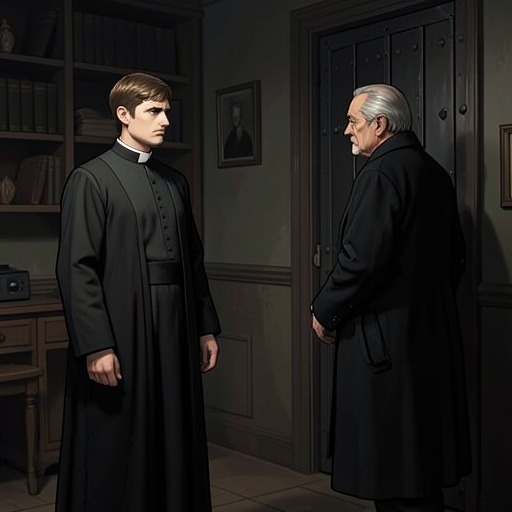
When Monseñor Spada explains the arrangement, he describes a plan to place Quart as an attaché at a nunciature, preferably in Latin America. Spada calls it a temporary exile, or perhaps a longer mission, and says he may reclaim Quart if circumstances improve and he remains in charge of the Institute for External Works. The proposal makes Bogotá less a chosen destination than a means of taking a politically exposed priest out of the way while the balance of power in Rome changes.
The posting follows the conflict over who should control the Seville inquiry. At first, the Holy Father wants a proper investigation without immediately involving the Congregation for the Doctrine of the Faith; the Institute for External Works is assigned the task, with escalation reserved for evidence of serious wrongdoing. Spada later admits that the inquiry also serves an internal Roman contest: a report substantial enough to show that the Institute is acting can satisfy the Pope and help keep Cardinal Iwaszkiewicz in check. Quart’s assignment to Seville is thus both investigative work and a move within ecclesiastical politics.
The Seville Dispute Behind the Transfer
The local stakes include the proposed use of the church site. Monseñor Corvo describes a redevelopment arrangement under which Banco Cartujano would compensate the diocese, finance a church in one of Seville’s poorest neighborhoods, and establish a foundation supporting social work among the Roma community. He presents the offer as beneficial to the diocese, despite its having only a moral claim to the land after three centuries of worship. The proposal remains stalled because Father Ferro refuses to yield.
Corvo’s posture toward the inquiry changes as Quart’s involvement deepens. He first characterizes Ferro as a mediocre priest and says the archdiocese could have dealt with him gradually; after outside intervention, Corvo declares that the matter is now for those who have entered it to handle. Later, he tells Gris Marsala that the affair belongs exclusively to Rome—or, in practice, to Quart—and disclaims responsibility while promising the support and prayers of the archdiocese. The contrast exposes how institutional authority can be asserted when useful and disavowed when the consequences become dangerous.
Distance and News from Seville
The novel eventually places Quart in Bogotá as a third secretary at the Apostolic Nunciature of Santa Fe de Bogotá. Five months into the posting, he learns from the international edition of ABC that Cruz Bruner de Lebrija, Duchess of Nuevo Extremo, has died at the beginning of winter. The newspaper notice carries her long list of titles and Macarena Bruner’s request for prayers. A few weeks later, a Sevilla-postmarked envelope brings a black-bordered memorial card repeating roughly the same announcement; there is no letter, but it contains the postcard from Nuestra Señora de las Lágrimas that Carlota Bruner had addressed to Captain Xaloc, once found by Quart in his hotel room.
Other information reaches him by equally indirect routes. A letter from Father Óscar Lobato travels from a small town in Almería to Rome and is forwarded on to Bogotá. It reports that Nuestra Señora de las Lágrimas remains open for worship and continues to function as a parish. The news gives Quart a concrete answer about the church’s survival, while its circuitous delivery underscores how much of his former life he can now know only through other people’s accounts.
Quart also learns of changes at Banco Cartujano through a brief notice in the American edition of El País. It reports Octavio Machuca’s retirement as chairman and the appointment of an unknown successor; the same notice records Pencho Gavira’s resignation and surrender of all executive powers as vice-president and managing director. These clipped reports do not restore Quart to the events he investigated, but they let him trace their aftermath from afar.
Narrative Significance
Bogotá marks a geographical and institutional withdrawal rather than a clean resolution. Spada frames the posting as temporary, dependent on future political conditions, while Quart’s correspondence and newspaper reading make distance itself part of the ending: the church’s continued worship, the deaths and departures in the Bruner household, and the changes at the bank arrive as separate pieces rather than a return to the scene.
The city therefore functions as the endpoint of Quart’s assignment and as a place of belated knowledge. He has been removed from Seville’s immediate conflicts, yet the postcard, the memorial card, Lobato’s letter, and the press notice keep that past present. The posting does not erase his connection to the people and institutions he left behind; it changes that connection into one of waiting, inference, and partial reports.